Thursday, 30 July 2015

British Championship Update - Day Five

On day three of the main British Championship, Paul found himself playing black against fellow Warwickshire Select player, and one time junior compatriot, Richard Weaving. When Paul chose to play the Alekhine defence I must say I was slightly worried, as he hasn't always been getting very pleasant positions in recent times, but on this occasion the opening must be regarded as a great success. After Richard appeared to overextend his pawn centre, Paul was able to infiltrate with his knight and win a pawn, raising hopes that an upset win with black could be on the cards. However, as so often happens when an opponent blunders a pawn, the couple of tempi it takes you to capture it gives them time to start generating counterplay, in this case in the form of a passed pawn on d6. Ultimately, Paul had nothing better than to sap off material into an entirely drawn opposite colour bishop endgame. Slightly anticlimactic, but a good result nonetheless.

It was Mark's turn today to find himself up against junior opposition and, through a slightly unusual opening line played against his opponents Sicilian, he somehow contrived to turn the position into something more resembling a Bird's opening. I believe at some point his opponent may have been starting to create a slight advantage, but Mark to was able to force piece exchanges to arrive at a completely level endgame, this time a rook endgame with a symmetrical pawn structure. Despite adopting the traditional anti-junior tactic of playing on in drawn endgames and hoping they won't know how to play it, no progress was possible and a draw was agreed. The other interesting news from the opening is that Andrew Paterson was winning his game against Mark Hebden, a pawn up with a better position. However, as he so often does, Hebden was able to create sufficient complications that, with time running short, Andy blundered and fell for a rook sacrifice that lead to mate.

In the senior's event, Bernard had a very confusing game where all the elements of it appeared to occur in the wrong order. Bernard tried on a number of occasions to sacrifice a pawn in the opening, which his opponent refused, and ultimately Bernard managed to get the same attack going anyway, without being material down. Then, when I next returned, Bernard's attack had vanished and he was also down a pawn. I can't think of any other explanation than that he sacrificed a pawn to stop his own attack. I decided this game was hurting my head to much so ceased watching at this point, but I am informed the final result was a draw. I shall let Mike's own words speak for themselves about his game. The report passed on was:

"Round 3 - yet another missed opportunity. Today I played David Anderton 5 times Senior champion and a CM and he produced an opening improvement on Avrukh which I managed to overcome with an idea of my own (we had both prepared the line) . That's the good news- we then got involved in a ten move combination involving my rook pinned against my queen with many subvariations and material imbalance at the end  of which I played the wrong reacapture of a piece with check and lost to a counter check-instead adding another piece to the jumble, which destroys his kings position,  would have won in 3 more moves . So two loses from totally won positions. Back to Larsen again for tomorrow."

I can't say I have the slightest idea from that what happened in his game, but I must say it sounds very impressive. I wish I could casually drop in the names of respected chess authors when analysing my games.

Speaking of myself, the boredom of the previous few rounds lifted today, as both my games ended in mating attack within the first 25 moves (one ended well for me, the other slightly less well). I think it probably says something (not entirely complementary) about my attitude to chess that I am considerably more pleased by the game I won in some style than I am depressed about the game I got crushed in. To satisfy both people who enjoy seeing me do well and enjoy seeing me crushed, I have provided both games. These will most likely be the last of my games to be on show from this tournament, as from tomorrow we are expecting a number of GM-GM clashes in each round, so there should be plenty of more competent chess to report on instead.


Summary thus far:
Total score by Kenilworth players: 25/51

My personal performance:
Played: 17
Wins: 8
Losses: 7
Draws: 2
Well played endgames: 5
Atrocious blunders: 5

Tuesday, 28 July 2015

British Championship Update - Day Four

We'll begin today by considering the main British Championship. Paul, after drawing with a junior in round 1, found himself with a very similar pairing in the second round. Fortunately, this time the advantage of the white pieces meant he was able to steer the game into a favourable line where his opponent had six of his seven pawns on light squares, surrounding his own very pacified bishop. The position mas almost certainly objectively somewhat better for Paul, but was also the perfect type of slow manoeuvring position that one would wish to play against the majority of juniors. Sure enough, Paul slowly outplayed his opponent, leading to the win of material and what appeared to be a fairly smooth victory. Mark, on the other hand, fresh from his round 1 match against GM Glenn Flear, was today playing a much lower rated opponent. Mark chose the King's Indian defence against d4, but his opponent rather unsportingly choose all the safest continuations, exchanging queens and then attempting to simplify the position as much as possible. Despite what appeared to be Mark's best efforts, no progress was made against such stubborn defence and a draw was the logical result.

The tournament also had its first major upset, with IM Jack Rudd going down after blundering a queen for two pieces in a complicated middlegame position. Also worth mentioning the exploits of local player and Leamington League regular Andrew Paterson, who won his second game in a row and is now odds on for strong GM opposition in round 3 (I'm guessing it will be Mark Hebden, but I've never fully understood British pairing rules).

In the seniors event, Mike also found himself going from playing one of the strongest players in the event in round 1 to one of the weaker possibilities in round 2. He, however, had a much easier time of it as his opponent chose a particularly limp opening and Mike was better as black after not much more than a dozen moves. Some precise manoeuvring later and the full point was duly achieved. Bernard's game, by contrast, mas a much more confusing affair. He appeared to make a mistake with the move order in the opening, and found himself in a very ugly position, ultimately forced to give up a pawn for either negligible or no compensation. I left the board with hi facing the possibility of a long and grim defence, and returned a few minutes later to find that he had won. I am still none the wiser as to how such a swift turn around occurred.

For myself, I have one piece of bad and two pieces of good news to report. The bad is that my game in the morning was one of the most boring games of chess ever played, with after 20 moves only a pair of rooks left on the board with a completely symmetrical pawn structure. Not necessarily a bad result with black, but certainly not worth the tournament entry fee to play games like that.The first piece of good news, although it does not directly involve me, is that the massive tournament favourite and 2490 rated Hungarian GM (highest rated in the tournament by 350 points) only managed a draw against a local junior in round 2. This pleased me in particular as I had beaten the same junior in the rapidplay only a few days before. The second thing to please me was that my afternoon game was much more enjoyable, with a crushing win in just 17 moves. The purists (or competent chess players) out there may well point out this says far more about how poorly my opponent played than about anything I did, but I achieve these things so rarely that I make no apologies to subjecting people to it.


Summary thus far:
Total score by Kenilworth players: 22.5/45

My personal performance:
Played: 15 Wins: 7
Losses: 6
Draws: 2
Well played endgames: 5
Atrocious blunders: 4

British Championship Update - Day Three

And so it is finally time for the main event to begin. I will leave the main championship until last and begin with some of the side events. With the exception of the absent Rajen Parekh (he was signed up to play in the U15 event in the morning but never appeared) I was the only Kenilworth player scheduled to play in the morning. Clearly both me and my opponent were still recovering from our exertions in the rapidplay the previous two days, as an extremely turgid and uninteresting game was played, which led to a draw without anything really happening at all. A sad end to my 100% record for decisive games.

The afternoon, however, saw a lot more Kenilworth players in action. Mike Donnelly and Bernard Charnley were both competing in the senior events, with contrasting fortunes in the draw. Bernard, with a grade slightly above the average for the event, found himself playing one of the, by grade, weaker players in the draw whilst Mike was up against the number 2 seed, Mike Surtees (who incidentally I have already lost to once in this tournament). Mike Surtees is known for playing rather irregular openings, and so it proved again with an extremely unbalanced position appearing on the board, with white (our Mike) suffering from doubled pawns but having excellent control of the centre in return. Mike tells me that after the game he discovered he had a win in the opening with an unexpected pawn sacrifice, but after he didn't find it he got slowly ground down, and unfortunately succumbed in the end. Bernard, on the other hand, opened with what looked like a fairly comfortable victory, so at least one Kenilworth player is off to a good start.

The less said about my game in the major open the better, as a slightly overoptimistic double pawn sacrifice in the opening left me with enough compensation for exactly one pawn. Unfortunately, some basic arithmetic will tell you this was unlikely to end well for me, and so it proved. However, my disappointment was mitigated somewhat by the knowledge I didn't make the worst mistakes of a local player in the event today. Dave Ireland, who many of you may know from his association with Coventry Chess Club, has a reputation for always turning up late for league games, despite living a 10 minute walk from the venue. Anyone expecting this pattern to change when he was pared with a 2490 Hungarian GM and the strongest player in the tournament by over 300 points will have been surprised, as he duly turned up 20 minutes and proceeded to play the first 20 moves so slowly he was down to 4 minutes with 20 moves still left to play before the first time control. I think everyone can fill in for themselves show that story ended.

On then to the main event, with our two gallant knights in action. The most attention for this round was on Mark, who found himself on board 8 against GM Glenn Flear. Around 15 moves into the game I found myself rather optimistic about Mark's position, as he appeared to be have successful pushed his opponent into quite a passive position. I don't know if Mark was also feeling good at this point, but looking at the online computer analysis of the game shows just why GMs win so many of their games. It transpires the engine thinks black was better for essentially the whole game, and after castling queenside an extremely vicious attack brought a premature end to proceedings, finishing with quite a nice (if you weren't playing the game on the other side) king hunt across the board. Paul on the other hand found himself just over halfway in the rating list and playing the second lowest rated player in the tournament (a 189 graded 15 year old). He appeared to be very slightly worse out of the opening, and remain that way for quite some time through a period of manoeuvring. Unfortunately I had to leave before the end of the game so didn't see the conclusion, but as the outcome was ultimately I draw I would assume Paul was eventually able to neutralise the pressure and equalise.

Summary thus far:
Total score by Kenilworth players: 17.5/39

My personal performance:
Played: 13
Wins: 6
Losses: 6
Draws: 1
Well played endgames: 5
Atrocious blunders: 4

I think we will close today with an excellent little miniature by Jonathan Hawkins on board 2. I'm sure we all wish we found it this easy to swat aside people graded 190.


Monday, 27 July 2015

British Championship Update - Day Two

Once again there were only three Kenilworth players in action today, for the second half of the rapidplay, so this report will be a short one before the main action of the tournament begins tomorrow. Mike Johnson continued his excellent run of results from yesterday, though it is fair to say that every time I came over to look as his board halfway through a game I felt that he was worse, but he would then find a way to draw the game and stay unbeaten. At one stage it look as though he may have been on course to challenge for one of the minor prizes. However, fatigue finally caught up with him in the end, with two defeats in the last three rounds, including a last round game against a 14 year old which lasted at least 80, and may have been over 100 moves. Still, a final score of 6.5/11 is more than creditable for a 127 graded player playing the U150 section.

On a slightly more unfortunate note, a similar consistency was also maintained by Ben, but not to such positive ends. The difficulty of being one of the lowest graded players in an open section was always going to present a challenge, and a final score of 3/11, Whilst disappointing, is probably around the score a grade of 150 would predict. Better results could perhaps have been achieved if time pressure had not caught up with him in a number of games. Finally, I had a fairly uneventful day, with 3 reasonable clean wins in endgames, and three games where poorly played openings led me to a bad position and eventual defeat without any real chances for a more positive result. A final score of 6/11 was respectable, but more importantly I managed 11 decisive games out of 11 without a single draw; a record I intend to try and keep up for the remainder of the tournament.

I made a point of writing down the moves from one of my games so I would have something specific to report, which turned out to be one of the games I ultimately won. However, after having shown the game to Paul, he informs me that it is so boring that it really isn't worth posting it. Personally I think that a game where more than half the pieces on the board have been exchanged by move 20 is a good one, but perhaps the majority of players will not agree with my sentiments. Therefore, further actual games from the event will have to wait until tomorrow.

Summary thus far:
Total score by Kenilworth players: 15.5/33

My personal performance:
Played: 11
Wins: 6
Losses: 5
Draws: 0
Well played endgames: 5
Atrocious blunders: 4

Saturday, 25 July 2015

British Championship Update - Day One

With the main championship not starting until Monday, only hardcore chess players or those with nothing else worthwhile to do with their lives (I think those two things may be equivalent) were expected to turn out for the opening weekend. I was quite surprised, therefore, to run into a number of players from Kenilworth and the surrounding area. In particular the appearances of Mike Johnson (a late entry into the U150 tournament) and Roy Watson (of whom more will be spoken later) led to a considerable local contingent being present. After a number of gripes from players about the choice of Warwick University as a location for the tournament, in particular the unimpressiveness of Coventry as a summer vacation location, I was pleased to note that overall everyone seemed satisfied with the venue itself. Hopefully this will continue when a more substantial number of people are present next week.

On to the results themselves. Two very creditable performances were produced by Coventry Chess Academy juniors in the U8 competition, with a score of 3/6 for one and 2/6 for the other highly satisfactory for local players against the best juniors from around the country. Ben Graff had a slightly harder time in main rapidplay with a score of 1.5/5, though consideration must be given for the fact that his grade of 150 made him one of the unluckiest entries in the tournament, as he was 1 point too high to play in the U150, and hence had to play in the open instead. I myself had somewhat of a better day, with a score of 3/5 and defeats only against people graded over 200. I also managed a personal best of only 1 piece blundered in 5 games, though unfortunately that one piece was a queen. Slightly strangely, the only game of mine I can now remember well enough to reconstruct for publication was from the opening round, and was perhaps my least interesting of the whole day. Still, I'm optimistic future days will provide more exciting fodder for dissemination. My most enjoyable moment of the day was after what I thought was a very clean win in round 4 on the white side of a Sicilian, Roy decided to take me aside and give me a lecture on all the things I had done wrong in the opening. All I can say is I am glad I had won the game, or this could have been exceedingly annoying.


The undoubted star of the day, however, was Mike Johnson, with a score of 4/5 in the U150 tournament leaving him with a hope of securing some prize money tomorrow. The highlight of his performance was the last round game, where he was playing a rook endgame with three pawns for each side. Mike was better due to the passive placement of his opponent's rook, but a long technical struggle appeared to be in offing. However, with Mike having his rook on g1 and his opponent his King on b4, an excellent self-destruction was achieved after Rb7, when Rb1+ forced immediate resignation. An excellent moment for Paul, Roy and myself who all happened to be watching the board at the time.

Paul, Roy and myself then decided to retire to the Zaika Lounge in Kenilworth for dinner after the completion of the day's events. Paul and I went on first, with Roy assuring us he was right behind. A slight concern was raised when he referred to a restaurant with elephants side, which neither Paul nor myself could remember, but we repeated the word Zaika to him many times, and were confident of success. Unfortunately, despite us waiting a considerable period of time, no eccentric Northerner ever appeared, and we were informed by the staff that there was indeed at one time a restaurant with elephants outside, but it had long since closed down. Therefore, if anyone walking down Kenilworth High Street over the next few days should happen across a confused chess player staring mournfully into shop windows do not be concerned; he is merely still searching for that elusive elephant who will serve him Onion Bhajis.

Summary thus far:
Total score by Kenilworth players: 8.5/15

My personal performance:
Played: 5
Points 3
Well played endgames: 3
Atrocious blunders: 1

Thursday, 23 July 2015

British Chess Championship - Preview

We are now barely a couple of weeks away from the exciting date when Mark Page and Paul Lam are declared joint British Champion, after an unfortunate mass poisoning at the dinner after the penultimate round leads to the withdraw of much of the rest of the field. As such, I thought it time to take stock of the Kenilworth players who will be participating in events this year. As it currently stands, we have:

Mark Page – Main Championship
Paul Lam – Main Championship
Mike Donnelly – Over 65s
Ben Graff – U150 and rapidplay
Bernard Charnley – Over 65s
Joshua Pink – Various (got to maximise my change of winning at least one game)
Rajen Parekh - U15

Some other people with a previous association with the club playing include:

Ed Goodwin – Over 65s and U160
Clive Blackburn – U125

We also have three members of the Coventry Chess Academy (run by our own Paul Lam) playing, one U11, one U9 and two in the U8s.

For people not playing, there is live commentary from IM Andrew Martin available on the championship website (http://www.britishchesschampionships.co.uk/2015/), and you can also go to the venue at Warwick University and watch the commentary live. I will be trying to update the blog fairly regularly with how we are getting on, but this obviously depends on how depressed I am with my own performance.

Finally, for people playing, I will be accepting game nominations in any of the following categories:

1) Best game played by a Kenilworth player
2) Worst game played by a Kenilworth player (in there just so I’ll win something)
3) Biggest upset achieved by a Kenilworth player
4) Worst move played by a Kenilworth player

The winners will be adjudicated by the strongest available judge associated with the club – the copy of HIARCS on my laptop. If anyone has ideas for other categories that should be added to the list let me know. The winner of each will be given a prize of one free game of playing the French Defence without me moaning about their choice.

Not long now until we find out, once and for all, just how bad we really are.

Sunday, 12 July 2015

Tournament Report - KIng's Place Rapidplay, July 11 2015

Yesterday I played in the monstrously strong (11 GMs and 10 IMs for starters) King's Place one day tournament, held next door to King's Cross station in London. The venue is pretty good, being a very new arts complex next-door to the Guardian/Observer offices and - very importantly - only 50 yards from a Pret A Manger and their bargain 99p cups of coffee. There were also U-170; U-145 and U-120 tournaments, and even a My First Chess Tournament for U-85s which seemed, though, to be populated entirely by mini-microbes.

This was my final/only warm-up event before the British Championships, and it certainly served its purpose in providing 6 games against a broad spectrum of reasonable to super-strong opposition.

In Round 1 I found myself on board 6 playing GM Gawain Jones, a positive bunny at rapidplay where he can only claim a rating of 2614 (ECF 253). Thankfully only the first 5 boards were relayed live, because I played a truly embarrassing game, managing to lose in 17 moves with the White pieces, having lost a piece for absolutely nothing on about move 14. When Black gets a rook onto an open e file which pins yr knight on e2 against your uncastled king and follows up with Bg4 after you've already played your pawn from f2 to f4, the omens are not good. And when he then plays b7-b5 attacking a bishop on c4 and follows with b5-b4 diving your c3 knight away, the e2 knight is likely to drop off. Which it did. This game can never be seen by anyone else. Ever.

Round 2 was rather easier, and I won a reasonably good game with black against a 1885/161 rated opponent. Round 3 and things got even better, as my pet new system against the dreaded French brought me an almost well-played victory over Phil Brooks (2216/210) who recently played a season or two for Shirley before returning South. I got a knight to a5 perpetually attacking a backward pawn on c6, but somehow Black defended. Although I still had the position under control I imprudently lashed out with a g4 pawn move and immediately wished I hadn't when my opponent found a couple of clever knight moves threatening awful forks on my king and queen. I had to un-attack the c6 pawn to get my knight into the game and promptly fell into another knight fork which swapped off the queens but cost me a pawn. Both of us were then surprised to discover that the resultant double knight ending was completely winning for me, as I could take two moves to attack the c6 pawn again and he couldn't do anything about it. Once that went his whole position fell apart.

So with 2 out of 3 I was once more in with the big boys, and got paired against IM Simon Ansell (2365/229) with Black. He played an English against me, and threw in an interesting exchange sac which netted him a pawn and the bishop pair. Amazingly I defended extremely well, giving up a pawn to swap off one of his bishops for my puny knight and getting my rooks active. Finally I gave the exchange back to produce an ending of rook and 2 pawns each, which he immediately agreed drawn.

Round 5 and I lost with white against FM Radovanovic (2253/217) from Serbia (who I beat at the Scarborough Open in 2013). I badly misjudged a position straight out of the opening and he got a monster knight on e4 which I could never shift. I defended as well as I could but eventually time pressure intervened and I fell apart.

By now my personal battery had virtually exhausted itself, but there was still a round to go. I was black against Jeremy Fraser Mitchell (2042/171), and he completely outplayed me with the Saemisch KID - luckily not something Roy is able to do too often at the Royal Oak. I got stuck with an awful isolated queen's pawn and he reduced me to grovelling around just to stay afloat. Somehow the crisis passed, and I stabilised the position and was at least level, but then I had a rush of blood to the head and sacced an exchange for what I hoped was a mating attack. It was just that, but unfortunately it was for White. But in a position where he had the happy choice between delivering perpetual check or mate in two, White contrived to lose on time. A very, very lucky escape!!

So overall, I finished with 3.5/6, a respectable 27th= position, and with a TPR of 6 x 211. (And hopefully a 35 ELO points boost for my somewhat depressed FIDE rapidplay rating.)

Overall winners were Luke McShane and Gawain Jones with 5.5/6, who took home £750 each. Third equal were GMs Howell and Hawkins and IMs Ghasi and Eggleston with 5/6, and they took home ...... precisely nothing!

So all in all a really excellent event, which is highly recommended to players of all standards. In fact I suggest a team outing next year. Only £23 return on a Virgin Trains cheap ticket from Coventry, and easy walking distance to the venue. Add in the proximity of the 99p cup of coffee and what's not to like??

Sunday, 21 June 2015

British Chess Championships, July 25 - August 8

Just a reminder to anyone thinking of joining Paul, Joshua and myself at this year's British Championships at Warwick University, that the deadline for entries without incurring a late fee is looming. After July 1 it will cost you more, and knowing what a tight fisted bunch chess players generally are, that's something to be avoided if possible.

This will be the first time since 1970 (also Warwick University) that the Championships have come right to our doorstep, and if it's another 45 year's before they come so close to home then most of us had better make use of what is likely to be our last such opportunity. (Sad but true!!)

Full details of all the events are here.

This will be the third time I have played at the British (first time ever in the Championship proper, of course), and my debut was half a life time ago at Southport in 1983. This was my highly enjoyable last round game in the Major Open (which was rather strong in those days), which is as far removed from my current turgid style as it's possible to get. The win took my score to 7/11 - and I will gladly settle for that this time around, too!


When I play through a game like that I sometimes get the weirdest feeling that I used to be a rather dynamic player - but I'm sure that's just false memory syndrome at work!

Tuesday, 9 June 2015

Kenilworth Player Profile: Part 1 - Paul Lam


Evening all. It gives me great pleasure to be making my first contribution to this site, a mere year and a half after it was created, thus proving that there is life in the club beyond Mark and Josh! It is with their encouragement that, from now on, I will be posting a regular series of Kenilworth player profiles consisting of Q & As which aim to shed light on the many colourful characters that make up our club. I for one am looking forward to conducting Roy Watson's interview! Upon their suggestion though, our series will kick off on a tamer note with none other than myself. I hope you will find the series interesting, entertaining and, dare I say, educational (in the sense of 'what not to do during a chess game'). Without further ado, let's move onto the questions!

Tell us a little about yourself and how long you have been playing chess for Kenilworth
I grew up and live in Coventry and work as a university administrator and chess coach. I joined Kenilworth Chess Club at the age of eleven in 2000 and currently play on board 1 for their A team in the Leamington & District Chess League.

How did you start playing chess?
My parents taught me the moves when I was 7 or 8, but I only started playing seriously in secondary school. I joined the school chess club, caught the bug, and soon found myself representing the school team. When I started regularly beating my peers and chess teacher I decided to join a club. I came down for a Kenilworth club night, really enjoyed myself and have been a member ever since.

What is the appeal of chess for you?
I enjoy the combative aspect of the game; for me there’s nothing better than the feeling of going ‘mano a mano’ and emerging victorious! As well as cultivating fighting spirit, chess has definitely helped me to develop other valuable 'life skills' such as concentration, problem-solving and resilience under pressure. One of the side benefits is that it has also enabled me to travel to some interesting places, meet new people and make many good friends.

What is your best chess feat/memory/moment?
There are a few which come to mind, such as representing England from under 14 to under 18 level, winning the LDCL division 1 title with Kenilworth A and my sacrificial win against International Master Richard Palliser in the 4NCL this season. My proudest achievement though is establishing the Coventry Chess Academy; a social enterprise providing chess tuition for children. I owe a great deal to the many people who helped me as a junior player, and it feels nice to be able to give back something to those in a similar position today.

What is your worst chess memory/moment?
One which still gives me nightmares is my game against Sam Williams in a vital 4NCL match during the 12/13 season. I outplayed my higher-rated opponent with the Black pieces and gained a completely winning position. I had one move to reach time control and a minute on my clock to do so. I had the option of checking the White king without fear of threefold repetition. Instead, I idiotically decided to try and calculate the quickest winning line. The next thing I knew, I checked my clock to see I had only three seconds left, panicked and put a piece en prise, forcing my resignation on the next move. Our team drew a match we should have won and were subsequently relegated. The whole painful reversal is available to view at http://chesstempo.com/gamedb/game/3424011 for anyone who wishes to share in my sorrow or, alternatively, laugh at my stupidity!

What is your favourite chess game?
Bobby Fischer’s 1963 miniature against Robert Byrne (http://chesstempo.com/gamedb/game/1219594). A clinical, logical game from beginning to end and what should have been one of the great finishes to a chess game, if it were not for Byrne resigning before it could be played!

Do you have a chess claim to fame?
I once shared the junior prize with Grandmaster David Howell, now one of the world’s top players, in a tournament and was almost the sole winner, as they initially missed out his name on the prize winners list!

Do you have a chess hero or inspiration?
Tony Miles, the UK’s first chess grandmaster of the modern era, who I had the pleasure of meeting a couple of times and playing once. I wrote an article about him for Ceasefire Magazine a few years ago which can be found at https://ceasefiremagazine.co.uk/chess-corner-4/ and which I feel adequately sums up my admiration for his style of play and accomplishments.

Do you have any funny chess stories?
One time I was playing in my school’s house chess competition. I won my game rather quickly and my chess teacher, Mr Jenkins, challenged me to a friendly game. I won, so we played another. And another. Fast forward two hours and everyone has gone home bar myself, Mr Jenkins, another teacher and my mum who is getting rather fed of waiting for me. I’ve lost count of the number of games we’ve played at this stage, but Mr Jenkins is still desperately seeking his first win. Eventually, I give in to tiredness and Mr Jenkins pounces like a leopard at the opportunity, finally securing victory. And I can finally go home much to the relief of my mum. It was worth the wait though to see the look of pure happiness on Mr Jenkins’ face after that final game!

What is the best piece of chess advice you’ve heard or were given?
Be pragmatic. Chess is a results-oriented game and the long but certain path to victory is preferable to the short but potentially hazardous one.

What are your interests outside of chess?
I’m a keen powerlifter and was the middleweight silver medallist in the 2014 British Bench Press Championship. I have qualified for the national Bench Press Championship on three separate occasions, all in different weight categories. Funnily enough, I qualified for the British Chess Championship for the first time only this year and don't have a chance in hell of winning, so I suppose my powerlifting achievements surpass those in chess!

Why would you recommend Kenilworth Chess Club?
It might not be the biggest club, but it’s definitely one of the friendliest. New members can expect a very warm welcome. Club nights are relaxed, highly sociable and terrific fun, even if the chess can be of questionable quality! As Mark Page once said, we all leave our grades at the door of the Royal Oak! 

Thursday, 4 June 2015

Trophy Time


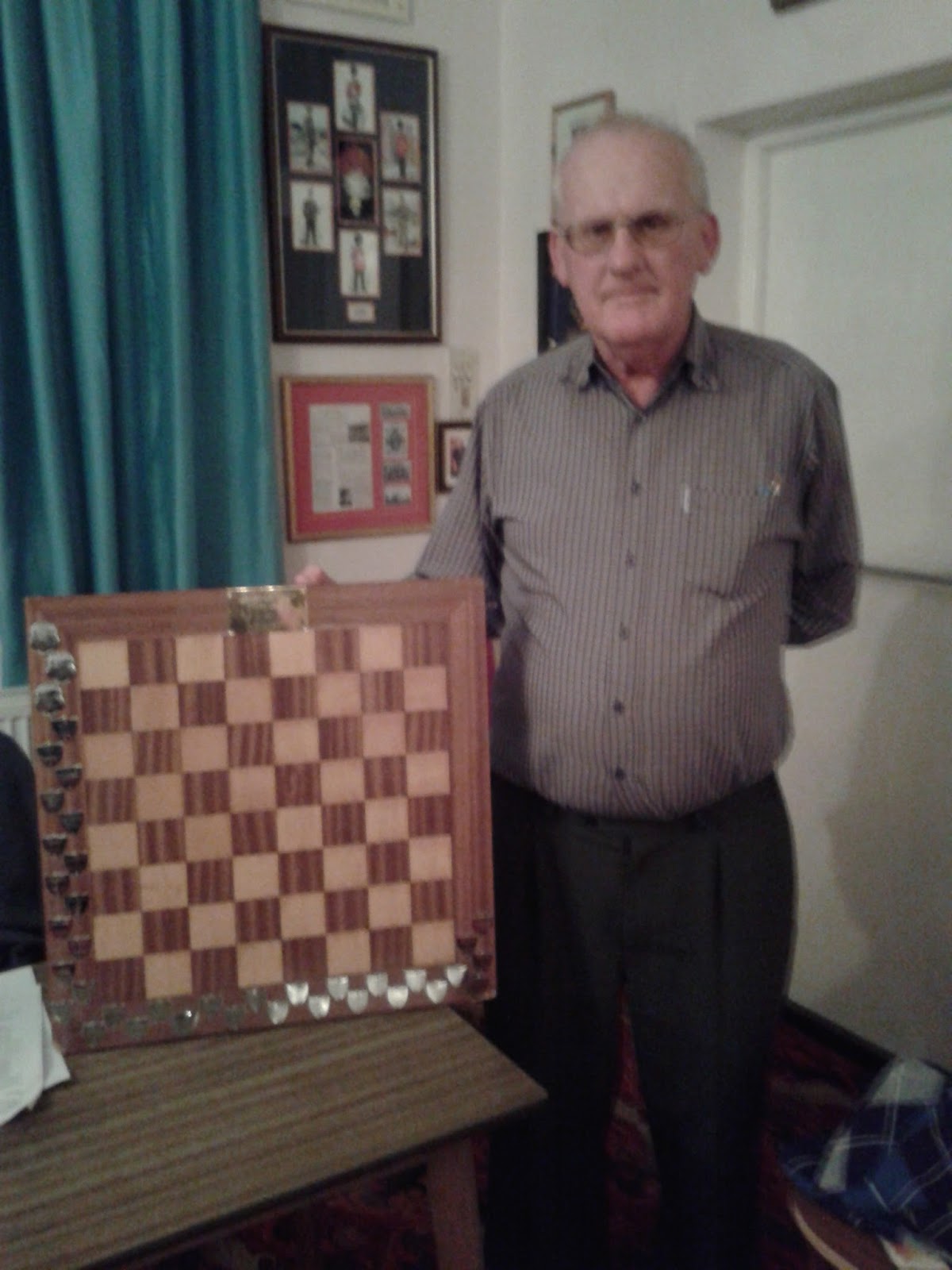
C Team captain Mike Johnson pictured with the Leamington League Division 3 Trophy at the League AGM which was held on June 1. Regrettably your roving reporter was not paying attention at the moment the Trophy was actually presented to Mike by the League Chairman, our very own Joshua Pink, so this will have to do!

Many congratulations once again to all those who contributed to the C team's success in the 2014-15 season.